Turn an idea into a circuit.
Choose real parts, read their values, place them on the breadboard, and make each electrical connection intentionally.


Play now · Electronics lab simulator
Build the circuit. Test the idea. Understand why it works. Protoboard turns a complete electronics bench into a place to learn, experiment, and invent.
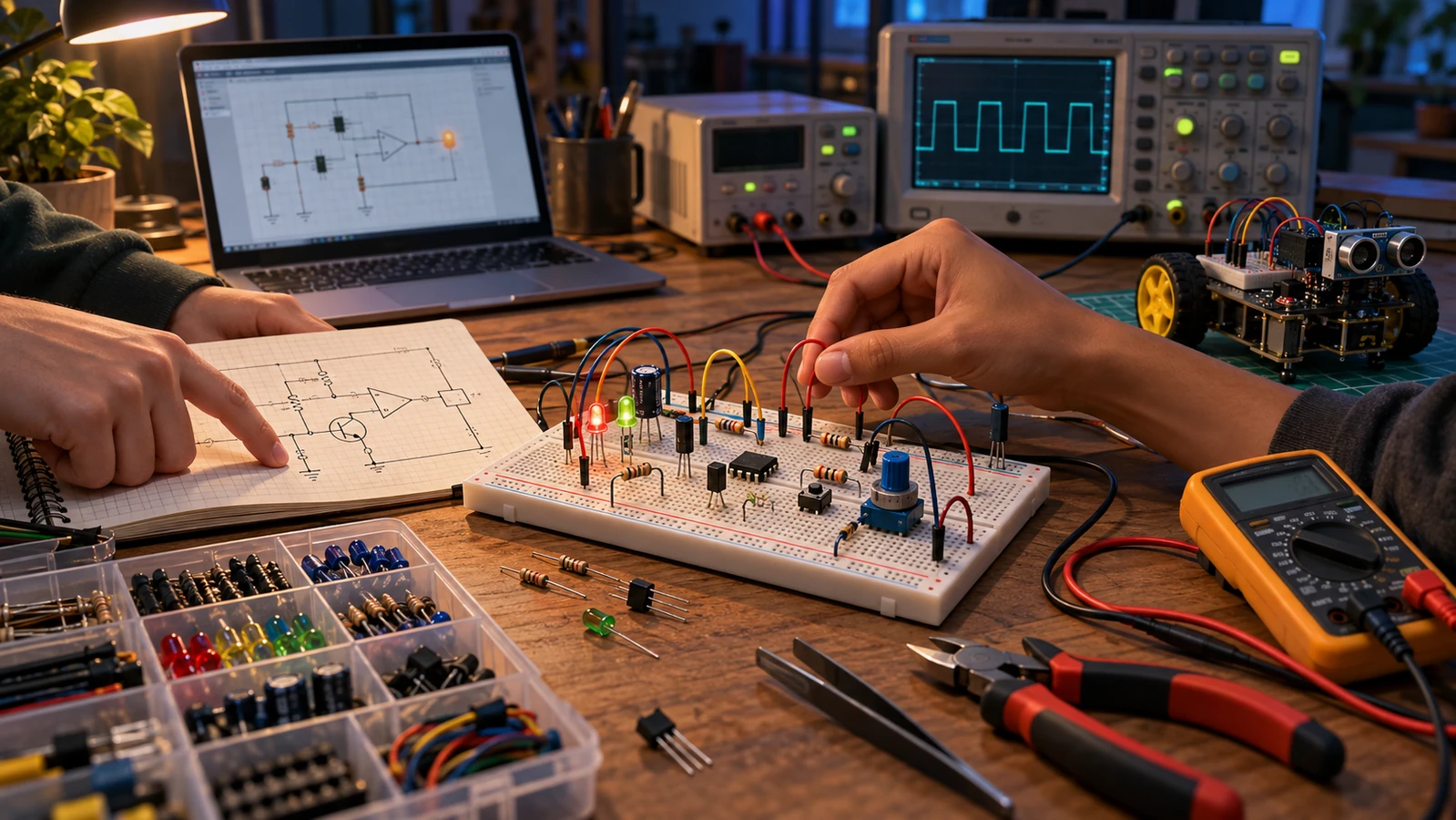
A workbench without the parts drawer
Protoboard simulates a solderless breadboard, electronic components, power sources, and test equipment using the behavior and characteristics of their real-world counterparts. Place a resistor, LED, capacitor, transistor, switch, or integrated circuit; connect the rails; apply power; and see how the circuit responds.
Voltage, current, resistance, polarity, timing, signal behavior, component tolerances, and failure conditions become things the player can observe and reason about. A multimeter and oscilloscope turn troubleshooting into part of the play.
The build-test-understand loop
Choose real parts, read their values, place them on the breadboard, and make each electrical connection intentionally.
Apply power, probe voltage and current, inspect signals, and compare the result with the circuit you meant to build.
Trace an open connection, reversed component, wrong value, overloaded part, or faulty assumption—and revise the design.
From screen to workbench
Guided projects use components and instructions that correspond to parts a player can obtain and assemble outside the game. Finish a working design, then follow the same circuit and build sequence with actual components.
Custom sandbox circuits can generate clean electronic diagrams and project guidance, giving an experiment a practical path from virtual prototype to physical build. Protoboard is designed to develop transferable knowledge in electronics, electrical engineering principles, measurement, schematic reading, component selection, and systematic troubleshooting.
Two ways to begin
Structured projects create a reason to learn each new idea, while the sandbox leaves room for original circuits and open-ended investigation.
Solve grounded challenges through projects that introduce parts, tools, and principles when the story gives them a job to do.
Move from first LEDs and switches into sensors, timing, analog behavior, logic, communication, and complete working devices.
Open a blank board, combine available parts, instrument the design, and use evidence to turn an idea into something reliable.
Future expansion
Later development is planned to introduce programmable microcontrollers and code-driven projects. Players will be able to connect inputs and outputs, write control logic, inspect what the program and circuit are doing together, and carry the same design into a physical build.
Protoboard is available to play now, while its component catalog, simulation depth, project library, diagram tools, and planned microcontroller support can continue to grow.
Visit the official Protoboard siteIdeas belong on the bench
From a first glowing LED to a programmable invention, make the connection and learn from the result.